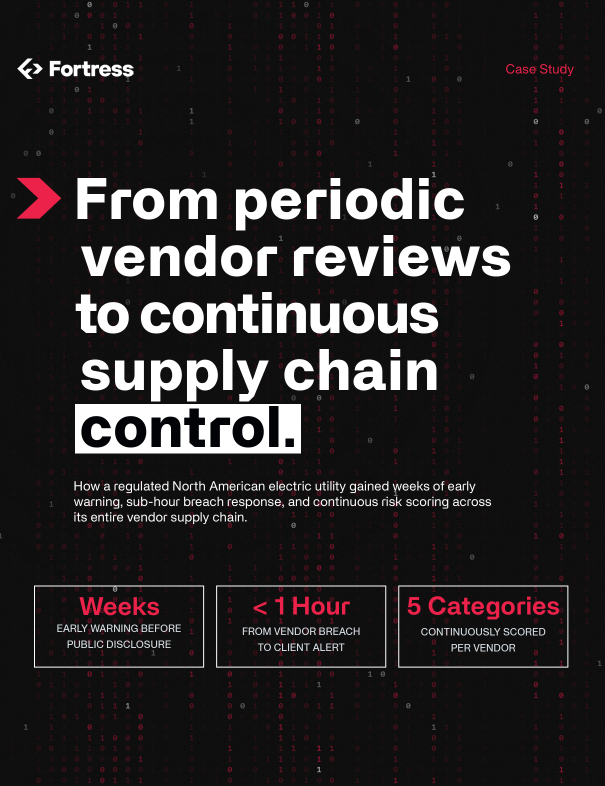
How a regulated North American electric utility replaced point-in-time vendor reviews with continuous, audit-ready supply chain risk management, and what that produced.
The problem this case study answers
Regulated utilities carry CIP-013 accountability for every vendor connected to their Bulk Electric System Cyber Assets. But most vendor risk programs assess posture point-in-time, while the threat landscape moves continuously. When a shared vendor is compromised, every utility on the grid inherits the exposure at once, and a program built on periodic reviews learns about it from the news.
This case study shows how one utility closed that gap.
What you'll learn
How Fortress combined framework-based Vendor Control Assessments with continuous AI Monitoring to deliver:
- Weeks of early warning on shared supply-chain threats, before public disclosure
- Breach notification in under one hour from detection to client alert
- Continuous risk scoring across five categories for a vendor population scaling past 2,000
- 33% faster vendor response and 50% less control-evaluation effort through scoped assessments
- A critical vendor exposure surfaced and remediated within 60 days, before any incident
Inside the case study
The full engagement walks through five capabilities in action: framework-based assessments aligned to CIP-013, continuous risk scoring across the entire vendor population, early warning on shared supply-chain threats including the MOVEit exploitation, foreign ownership and nation-state exposure detection, and real-time breach notification.
You'll see how vendor risk shifted from a periodic, reactive exercise to a continuous, measurable one, and why that matters when the average utility breach reached an all-time high in 2025 and NERC CIP penalty exposure reaches up to $1.54M per violation per day.
Who should read this
TPRM, GRC, and security leaders at regulated utilities and critical infrastructure operators accountable for CIP-013 vendor risk management.