Most Third‑Party Risk Management programs fail because they generate alerts and dashboards rather than driving remediation and risk reduction.
Effective TPRM software must connect monitoring to prioritization, ownership, and action.
Why do TPRM programs fail to reduce risk?
Because they stop at visibility.
Common failure points include:
- Alert fatigue
- Lack of ownership for findings
- No structured remediation process
- Misalignment between security and procurement
According to Fortress practitioners, this creates a gap between risk identification and risk reduction.
What is the difference between insight and action in TPRM?
Insight is knowing a vendor has risk. Action is resolving it.
Most platforms provide:
- Risk scores
- Alerts
- Reports
But lack:
- Workflow assignment
- Vendor engagement
- Evidence tracking
Fortress emphasizes that TPRM must deliver conclusive results, not raw data.
How does AI improve actionability in TPRM?
AI improves action by:
- Prioritizing the most impactful risks
- Correlating signals across domains
- Reducing noise in large data sets
Fortress combines AI with human validation to ensure decisions are:
- Accurate
- Defensible
- Aligned to operational impact

What does an action-driven TPRM program look like?
An effective program includes:
- Assigned ownership for every finding
- Defined remediation steps
- Measurable timelines
- Evidence-based closure
This creates a closed loop between detection and resolution.
Fortress Framework: From Signal to Resolution
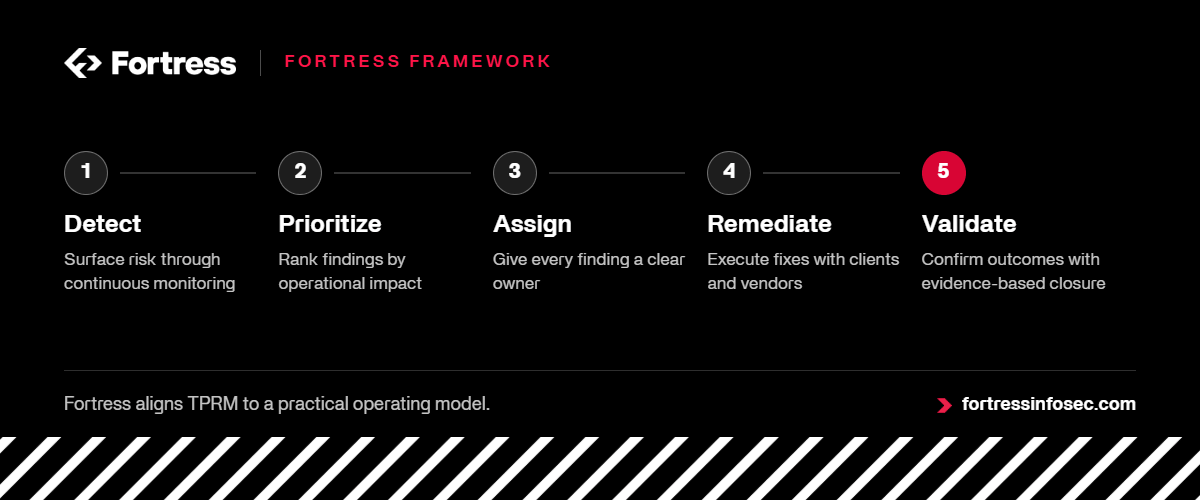
Fortress aligns TPRM to a practical operating model:
- Detect risk through monitoring
- Prioritize based on impact
- Assign ownership
- Execute remediation
- Validate outcomes
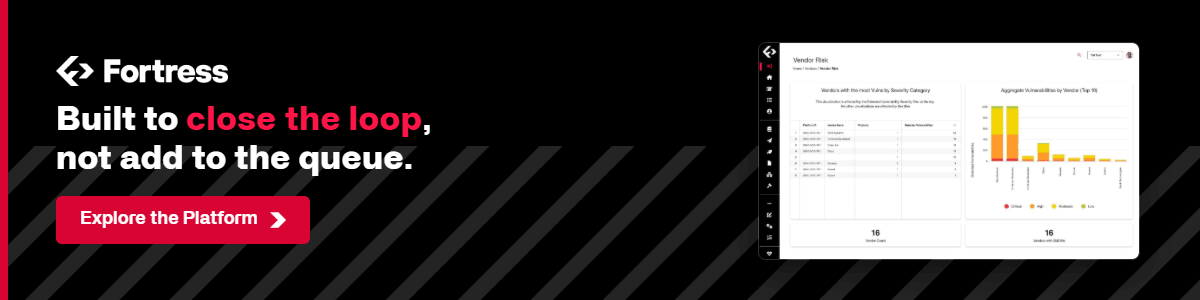
Why Fortress: Built to Close the Loop, Not Add to the Queue
Most platforms stop at the finding. Fortress is built for what happens next. Where other tools generate more alerts, Fortress connects monitoring to prioritization, ownership, and resolution, so risk actually goes down.
The difference shows up in the operating model:
- Prioritized, context-rich insight. Fortress applies an Operational Risk Translation Layer that aligns supplier cyber risk to the systems, assets, and services that keep infrastructure running, so teams act on what matters instead of triaging noise.
- AI paired with human validation. Fortress combines AI-driven monitoring with analyst oversight, producing decisions that are accurate, defensible, and mapped to operational impact.
- Remediation, not just reporting. Fortress does not stop at finding vulnerabilities. Built-in remediation workflows and optional managed services drive findings to closure, working alongside clients and their vendors to implement fixes.
- Regulator-defensible outcomes. The result is documentation of risk reduction, not a growing backlog of unaddressed findings.
- Shared intelligence at scale. Through the NAESAD and A2V data exchanges, risk identified for one operator becomes a shared signal for all, keeping triage tractable as AI accelerates discovery.
That is the closed loop between detection and resolution: detect, prioritize, assign, remediate, validate. Insight tells you a vendor has risk. Fortress helps you resolve it.